Page Audit
The engine classifies the page into one of 8 types (Local Business, YMYL, E-commerce, etc.), then runs evaluation modules - Traditional SEO, RAG, AI Readiness, Link Audit, Schema, E-E-A-T, Subjectivity Filter - all rule-based, no LLMs.
Trusted by 1000+ active users from brands and agencies worldwide
Page classification (logic gates)
Before evaluation, the engine classifies the page into one of 8 page types. Each type has its own scoring rules - so a local plumber’s site isn’t penalized for missing academic citations, and a YMYL page is held to stricter authority standards.
Local Business
NAP consistency, geo signals, service area
YMYL (Your Money Your Life)
Health, finance, legal - stricter authority requirements
SaaS / Software
Feature clarity, pricing transparency
E-commerce
Product schema, pricing, reviews
News / Editorial
Datelines, authorship, freshness
Support / FAQ
Answer completeness, structured Q&A
Entity Root
Brand or organization hub pages
Other / General
Default rules when no specific type fits
What the audit evaluates
After classifying the page (e.g. Local Business, YMYL, E-commerce), the engine runs modules in sequence - no LLMs. Order: Traditional SEO, RAG Optimization, AI Readiness, Link Audit, Schema Engine, E-E-A-T, Subjectivity Filter. Before you start with our AI rank tracker, use this audit to fix critical crawlability, schema, and trust gaps first.
Subjectivity Filter detects vague marketing language ("world-class", "cutting-edge") and applies a penalty based on fluff density.
| Area | What it measures |
|---|---|
| Human Trust | Traditional SEO, E-E-A-T, internal links |
| AI Citation | RAG, AI Readiness, link grounding, Schema; gated by crawlability |
| Contextual Autonomy | Per-section topic persistence, pronoun independence, self-contained nuggets |
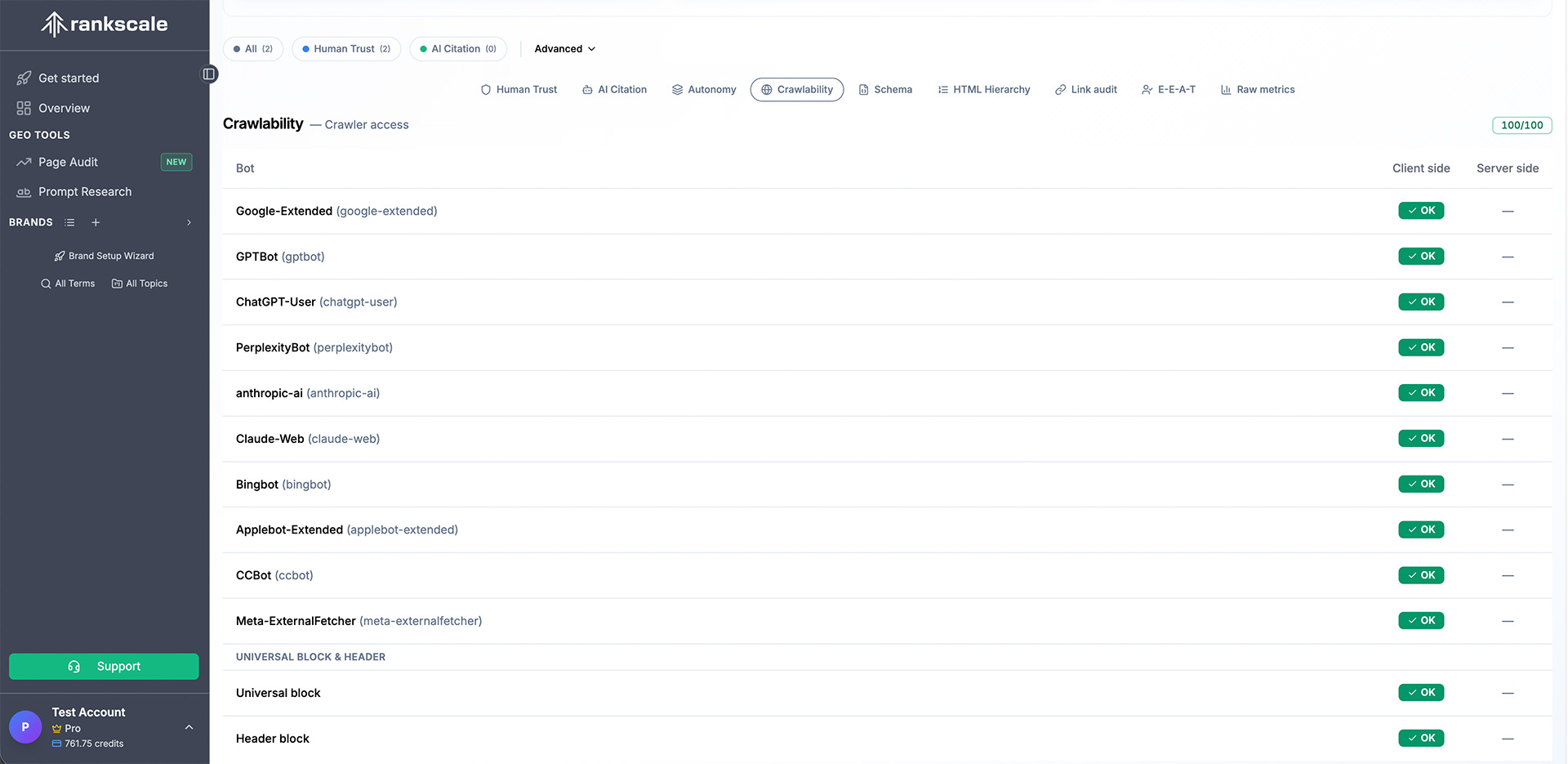
| AI Crawlability | Penalties for each blocked AI bot (e.g. GPTBot, PerplexityBot) |
| Schema | Universal + conditional + badging + taxonomy; alignment penalty when markup and visible content diverge |
| E-E-A-T | First-hand experience, credentials, accreditation, conflict-of-interest, visual verification |
| Rendering Readiness | Optional: H1/meta/canonical match, content delta, noscript; only when rendering check is on |
Why Use the Page Audit?
Rankscale delivers a single, high-level view of how any URL supports both human trust and AI citation. Clear status and actionable recommendations.
Fix Before You Publish
Rankscale audits key URLs so you can catch crawlability, schema alignment, and content issues before they hurt visibility. Prioritized recommendations you can act on.
Balance Human & AI
Rankscale surfaces whether a page is over-optimized for one side (ai-trap or hidden-gem). Rebalance for the perfect mix with clear status.
Deterministic & Fast
Rankscale uses Cheerio, JSON-LD parse, and rule-based evaluation - no LLMs in the audit engine. Deterministic, fast results; optional rendering check when you need it.
“Rankscale's website audit feature provides incredible insights into AI visibility opportunities.”
Head of SEO
Related features
Explore more ways to monitor and improve your AI visibility.
Frequently Asked Questions
Rankscale answers common questions about the Page Audit and Perfect Mix Auditor.
Rankscale first classifies the page into one of 8 types (e.g. Local Business, YMYL, E-commerce, News/Editorial). Then it runs modules in sequence: Traditional SEO, RAG Optimization, AI Readiness, Link Audit, Schema Engine, E-E-A-T, and Subjectivity Filter. You get Human Trust and AI Citation evaluation, a status (perfect-mix, ai-trap, or hidden-gem), and prioritized recommendations.
Still have questions? Contact our team