The Form Before the Answer: How ChatGPT Questions Buyers Before Recommending Anything
Four in five buying prompts in ChatGPT get a questionnaire before any recommendation. Most arrive already filled in, and what they ask is a brief that brands can write to.
Tell ChatGPT you want to buy something and four times in five it answers with a questionnaire. In 7,313 answers to 765 buying prompts across Germany, the UK and the US, 79.4% carried a follow-up form. Budget was asked in 87.1% of those forms. Brand was asked in 0.4%.
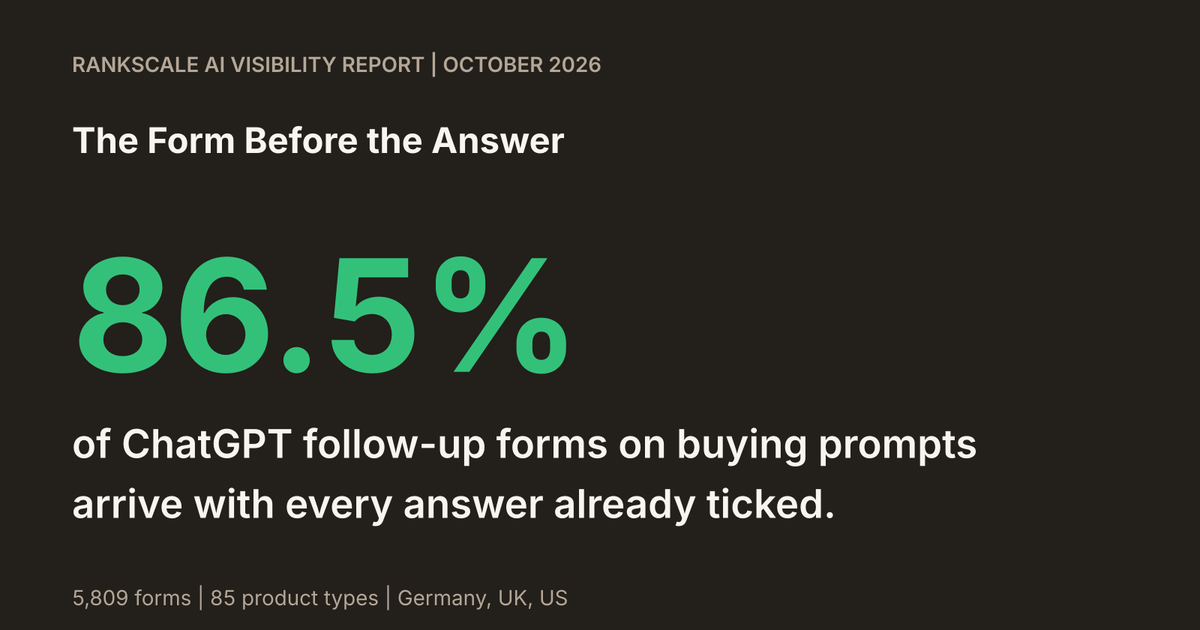
The form looks like a clarifying step. It works more like a briefing: ChatGPT decides which questions matter and ticks an answer for nearly all of them. 86.5% of forms arrive fully filled in, and nine in ten budget questions come with the middle price band selected. For anyone selling a product, those questions and their defaults are the brief that decides what gets recommended.
This is a neutral study with no sponsoring brand. Every figure comes from raw ChatGPT answers collected through the Rankscale API on 20 and 21 October 2026.
What is a ChatGPT follow-up form?
A ChatGPT follow-up form is the short questionnaire ChatGPT shows under its answer to a buying or recommendation prompt. It asks about things like budget, use case, household or who the product is for, offers a fixed set of answer options for each question, usually pre-selects one of them, and turns the answers into a refined prompt for a tailored recommendation. OpenAI describes a similar step in its shopping research in ChatGPT, which asks “clarifying questions about things like your budget, who the item is for, or which features you care about”. Rankscale records these forms on tracked prompts with its ChatGPT follow-up forms feature, which is where the data in this study comes from.
What the form gives away
Each follow-up form is ChatGPT showing its working. For every product and market it reveals five things that used to take a research budget to find out:
- The brief. The questions ChatGPT needs answered before it recommends anything. For running shoes it is budget, where you run and how experienced you are; for pain relief, who the medicine is for and the symptoms. These are the questions a product page has to answer.
- The default buyer. The answers it ticks before the buyer touches anything. In running shoe forms, the UK ticks “roads and pavements” in all 24 forms, Germany assumes a beginner in 25 of 28, and the US pre-selects a $100 to $150 budget in 24 of 27. Video game forms assume a PlayStation 5 in 80 of 85; language app forms in the US and UK pick Spanish in 47 of 48.
- The price ladder. The bands it offers are its picture of what the product costs in that market, and the ticked middle band is where it steers.
- The segmentation. The options are ChatGPT’s own map of the category: use cases, sizes, situations, in the exact words it will match against.
- The next search. The prompt it writes from the answers shows what it looks for once the form is sent: current prices, purchase links, retailers.
None of this needs a survey or a panel. It is in the answer, for every prompt, every run and every market.
Four in five buying prompts get a questionnaire
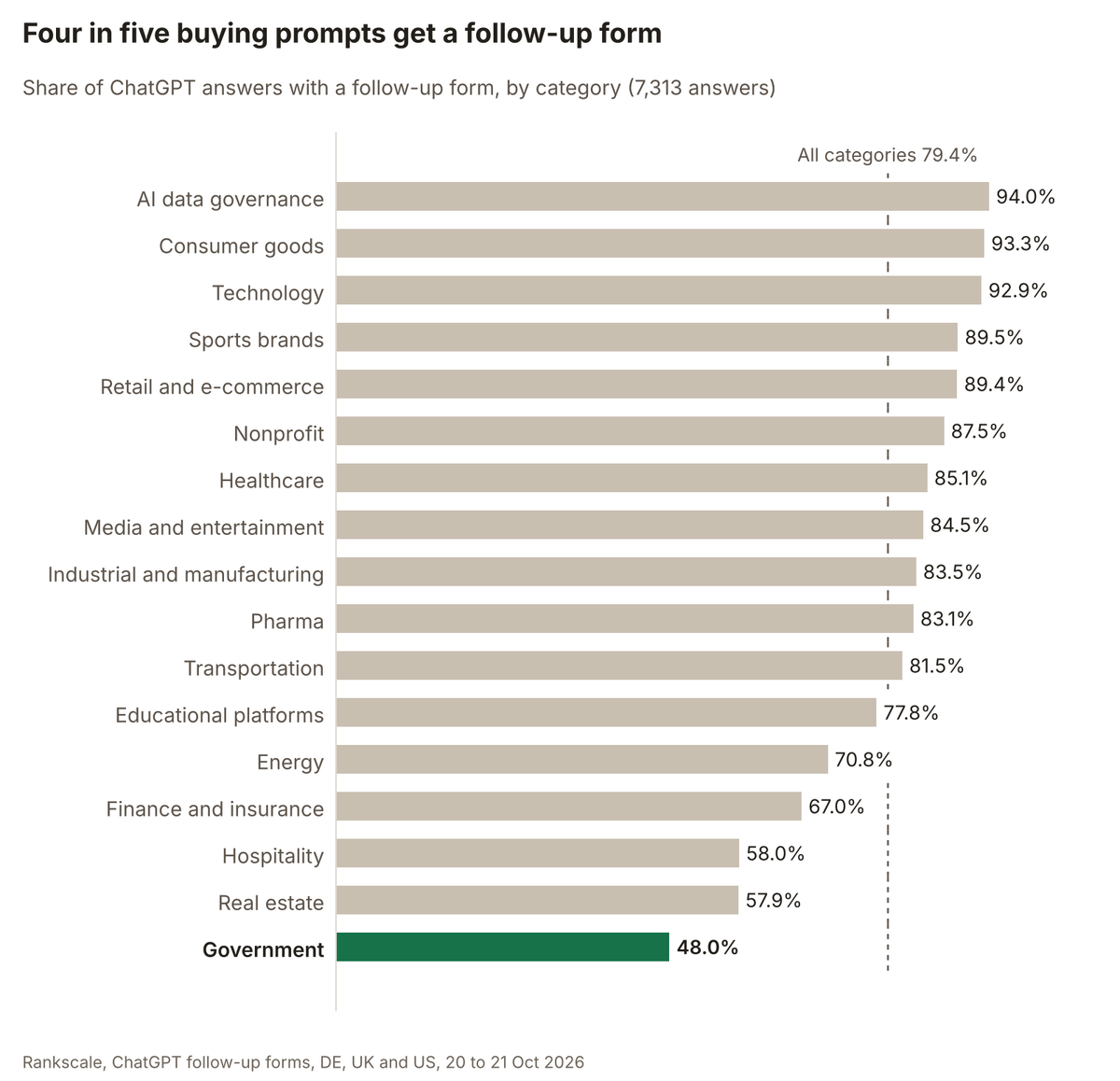
Share of ChatGPT answers with a follow-up form, 7,313 answers, 17 categories.
Standard products almost always get a form: AI data governance tools 94.0%, consumer goods 93.3%, technology 92.9%. Regulated, local or very personal purchases mostly get a direct answer instead. Government services get a form in 48.0% of answers, real estate in 57.9%, and travel visas in 7 of 86. Germany gets the most forms (83.4%), ahead of the US (78.4%) and the UK (76.6%).
ChatGPT asks for a budget, almost never for a brand
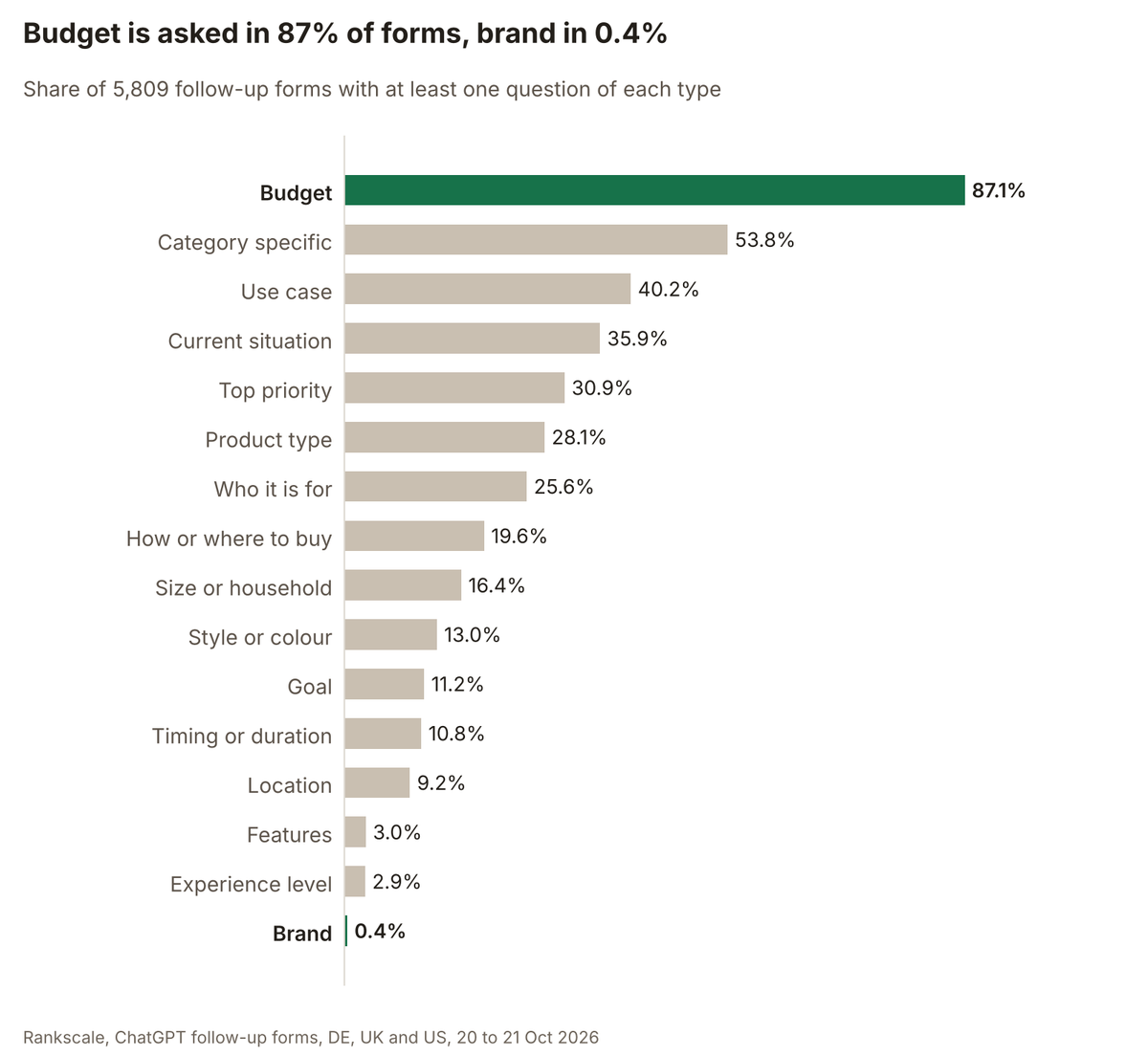
Share of 5,809 follow-up forms with at least one question of each type. Question types assigned by keyword rules in English and German.
Budget is asked in 87.1% of forms; brand in 0.4%, 21 of 5,809 forms, mostly for handbags and football boots. ChatGPT treats the brand as its own decision, made from what the buyer tells it about money, use and situation. A form holds 4.4 questions on average, almost all of them single choice, and budget is the one constant among them.
Beyond budget, each product gets its own interview:
Product | Forms | Most asked question types |
|---|---|---|
Washing machine | 84 | Budget 100%, top priority 91.7%, household size 77.4% |
Laptop | 79 | Budget 100%, use case 94.9%, operating system and other current setup 92.4% |
Running shoes | 79 | Budget 100%, use case 89.9% (“Where will you run?”), current situation 51.9% |
Pain relief medication | 60 | Who it is for 96.7% (age), current situation 71.7% (symptoms), budget 23.3% |
Data governance platform | 86 | Budget 98.8%, organisation size 97.7%, goal 36.0% |
Credit card | 78 | Category specific 88.5% (credit history, card perks), use case 62.8%, how or where to buy 61.5%, budget 47.4% |
The more personal or regulated the purchase, the less the form is about money: pain relief asks for age before price, and credit cards ask about budget in fewer than half of their forms.
Most forms arrive already filled in
86.5% of forms, 5,023 of 5,809, arrive with every question already answered by ChatGPT. Across 24,788 choice questions, 99.4% carry a pre-selected option; only 9 forms had none at all. The button underneath reads “Find my best options” or a variant of it. A buyer who presses it without changing anything sends ChatGPT’s own assumptions back as their brief.
The escape hatch is built in too. A “not sure” or “recommend for me” option appears in 6,101 choice questions, and in 22.5% of those it is the one ChatGPT ticks. Form length follows the complexity of the purchase: hospitality forms run longest at 6.1 questions (dates, travellers, destination), government services shortest at 3.4.
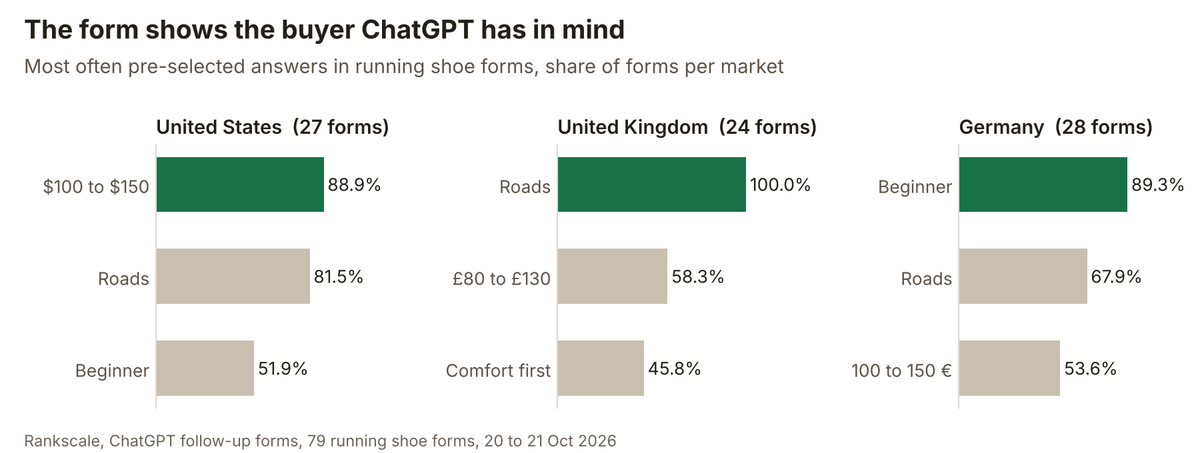
Most often pre-selected answers in running shoe forms, 79 forms, three prompts per market. Close wording variants counted together.
The defaults describe the buyer ChatGPT has in mind. For running shoes that buyer runs on roads in every market, is a beginner in Germany, puts comfort first in the UK and spends $100 to $150 in the US. A brand built for trail or racing starts every one of these conversations outside the default.
ChatGPT ticks the middle price band for you
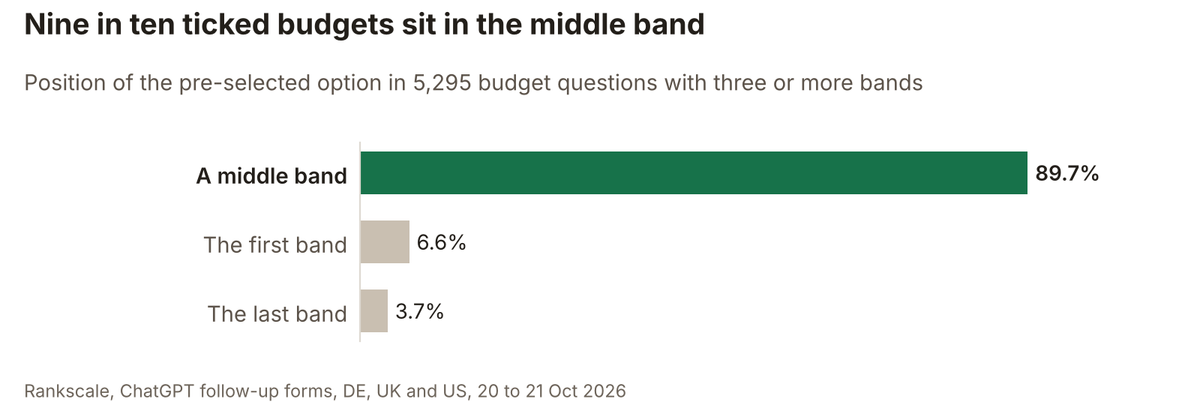
Position of the pre-selected option in 5,295 budget questions with three or more bands.
Nine budget questions in ten arrive with a middle price band already selected: 4,750 of 5,295. ChatGPT usually offers a ladder of four or five bands and pre-selects one in the middle. That default is a price anchor. A buyer who submits the form without changing it hands ChatGPT a budget ChatGPT chose, and the recommendation follows that band. The bands also differ sharply by market:
Product | Default band US | Default band UK | Default band DE |
|---|---|---|---|
E-bike | $1,000 to $1,500 | £1,000 to £1,500 | 2,000 to 3,000 € |
Heat pump | $8,000 to $15,000 | £5,000 to £8,000 | 15,000 to 25,000 € |
Coffee machine | $200 to $500 | £200 to £400 | 300 to 500 € |
Washing machine | $600 to $900 | £250 to £350 | 400 to 600 € |
Smartphone | $500 to $800 | £200 to £400 | 300 to 500 € |
Used car | $10,000 to $15,000 | £3,000 to £5,000 | 10,000 to 15,000 € |
Investment property | $300,000 to $500,000 | £100,000 to £200,000 | 50,000 to 100,000 € |
The most common pre-selected band per product and market, about 20 to 30 forms each.
Germany stands out on coffee machines, where 26 of 28 forms default to 300 to 500 €, the fully automatic segment, and on e-bikes and heat pumps, where the German default band is roughly double the US one in nominal terms.
Ask twice and the form changes
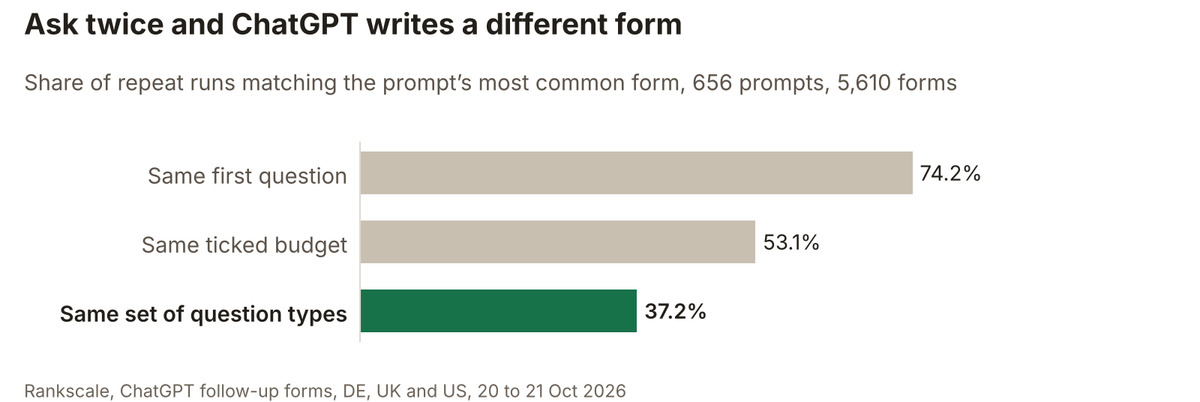
656 prompts with at least five forms each, 5,610 forms.
The form is written fresh for every answer, not pulled from a template. Repeat runs of the same prompt keep the same first question 74.2% of the time, the same ticked budget 53.1%, and the same set of question types only 37.2%.
That makes a single run close to meaningless. Tracked over about nine runs, the average prompt showed this spread:
Per prompt, across repeated runs | Average |
|---|---|
Different question types asked | 6.7 |
Question types asked in at least half of the runs | 3.9 |
Question types that only show up now and then | 2.8 |
Different question wordings | 21.0 |
Different budget bands ticked as the default | 3.8 |
656 prompts with at least five forms each, 5,610 forms, 8.6 forms per prompt on average.
One screenshot shows one draw from that spread. Only repeated tracking separates the core of the form, the questions, options and pre-selections that come back run after run, from the ones that rotate. That core is what buyers meet most often, and it is what content and pricing should be built against.
Phrasing moves the form as well. “Help me buy X” produces the longest interview at 4.7 questions, against 4.3 for “Which X should I buy?” and 4.2 for “I want to buy X”. Tracking several phrasings of the same intent is part of the same discipline.
The form ends in a shopping request
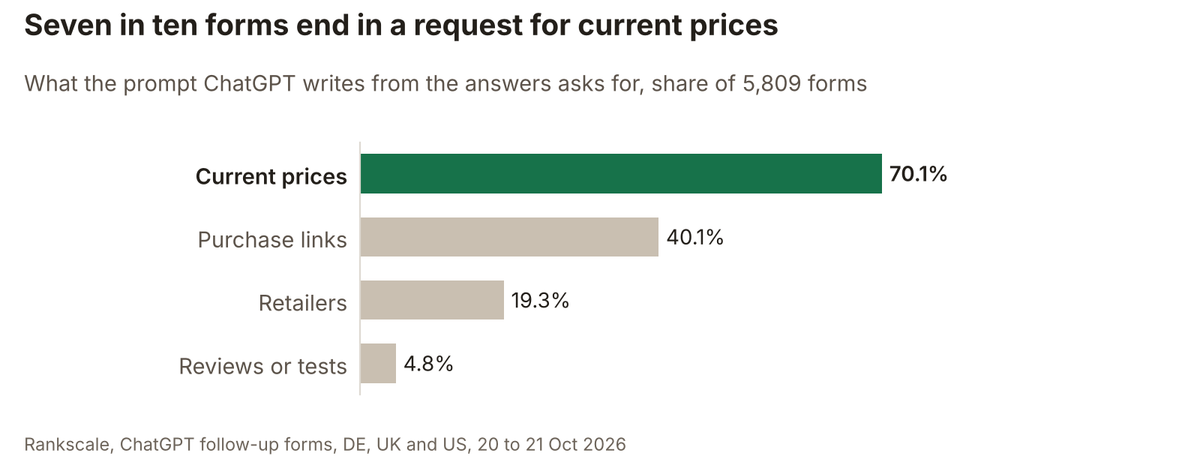
Share of 5,809 follow-up forms whose generated prompt asks for each.
Every form comes with a prompt ChatGPT writes for itself from the answers. A typical one:
Recommend running shoes to buy in the UK. Terrain: {terrain}. Budget: {budget}. Priority: {priority}. Running experience: {experience}. Include specific models, current prices and purchase links.
Seven in ten of these prompts ask for current prices, four in ten for purchase links. The second turn is a price and availability check, not a research question. Our reading, which the data supports but does not prove: whatever product data ChatGPT can retrieve at that moment, price, stock and where to buy, shapes the final list.
What to do with the forms
The form tells brands exactly which questions their content has to answer, product type by product type and market by market. Six things follow from the data.
- Read the form as the category brief. For running shoes it is budget, where you run and how experienced you are; for pain relief, who the medicine is for and the symptoms; for data governance platforms, budget and organisation size. Product pages and guides that answer those questions in those terms give ChatGPT what it needs after the form.
- Write for the ticked answers. Most buyers will submit what ChatGPT pre-selected: the middle price band, its default priority, its default household. If your product sits outside those defaults, content has to make the case for moving the slider, in that market’s currency and price logic.
- Use the options as segmentation. The bands and choices ChatGPT offers are its own map of the category: price ladders, use cases, sizes, situations. Map each product to a segment in exactly those words, for example “for households of 2 to 4” or “for trail running”.
- Track the form repeatedly, not once. Only 37.2% of repeat runs show the same set of question types, and a prompt cycles through 3.8 different default budgets on average. Only tracking over many runs and phrasings shows which questions, answers and pre-selections come most, and that is the version buyers actually see. Rankscale’s AI rank tracker runs prompts on a schedule for exactly this.
- Make price and availability retrievable. The prompt written from the form asks for current prices in 70.1% of cases. Clean product feeds, merchant listings and visible prices are what the second turn can read.
- Treat direct-answer categories differently. Government services, real estate, finance and energy get a form far less often. There ChatGPT answers directly and points to official bodies, portals and comparison sites, so being cited by those is what counts.
How this was measured
- Prompts: 765 buying prompts. 17 categories with five product types each, three phrasings per product (“I want to buy X”, “Help me buy X”, “Which X should I buy?”), in German for Germany and English for the UK and US. Travel and hotel prompts used “book” instead of “buy”.
- Engine: ChatGPT web interface, tracked with Rankscale. The follow-up form, its questions, options, pre-selected answers and the prompt ChatGPT writes from them were read from every answer.
- Sample: 7,313 answers and 5,809 follow-up forms from hourly runs on 756 prompts, 20 to 21 October 2026.
- Question types: each form question was assigned to one type by keyword rules in English and German. Questions that matched no general type count as category specific.
Rankscale tracks ChatGPT follow-up forms per prompt, market and phrasing, alongside visibility, sources and citations. More research on the Rankscale blog, or start at rankscale.ai.
Frequently Asked Questions
- What is a ChatGPT follow-up form?
- A ChatGPT follow-up form is the short questionnaire ChatGPT shows under its answer to a buying or recommendation prompt. It asks about things like budget, use case, household or who the product is for, offers fixed answer options for each question, usually pre-selects one of them, and turns the answers into a refined prompt for a tailored recommendation.
- How often does ChatGPT show a follow-up form on buying prompts?
- In this study 79.4% of 7,313 ChatGPT answers to buying prompts carried a follow-up form. The rate ranged from 94.0% for AI data governance tools to 48.0% for government services across 17 categories in Germany, the UK and the US.
- What does a ChatGPT follow-up form ask?
- Budget is asked in 87.1% of forms and brand in only 0.4%. Beyond budget each product gets its own questions: where you run and how experienced you are for running shoes, age and symptoms for pain relief, organisation size for data governance software.
- Does ChatGPT pre-select answers in the follow-up form?
- Yes. 86.5% of forms arrive with every question already answered, 99.4% of choice questions carry a pre-selected option, and nine in ten budget questions default to a middle price band.
- Is the ChatGPT follow-up form the same every time?
- No. Repeat runs of the same prompt show the same set of question types only 37.2% of the time, and a prompt cycles through 3.8 different default budget bands on average. Only repeated tracking shows which questions, answers and pre-selections come most.
- How can brands use ChatGPT follow-up forms?
- Treat the form as the category brief: answer its questions on product pages in its own words, position against the defaults ChatGPT ticks in each market, map products to the options it offers, track the form repeatedly, and keep prices and availability retrievable for the prompt ChatGPT writes from the answers.