We now support Meta Muse Spark. Track your Spark prompts

Free course | 8 modules | about 4 hours of video

AI SearchBootcamp

Learn how to get your brand mentioned, cited, and recommended by ChatGPT, Google AI Overviews, Perplexity, Gemini, Copilot, and Claude in eight free hands-on modules.

Free. Complete all assignments and earn your AI Search Strategist badge, plus a GEO / AI Search Agency badge for your agency.

Last updated:

Earn your badge

Submit the assignment under each of Modules 1, 2, 3, 4, 5, and 7, using the same email address every time. Agencies that submit all assignments also earn the GEO / AI Search Agency badge.

For you

AI Search Strategist badge
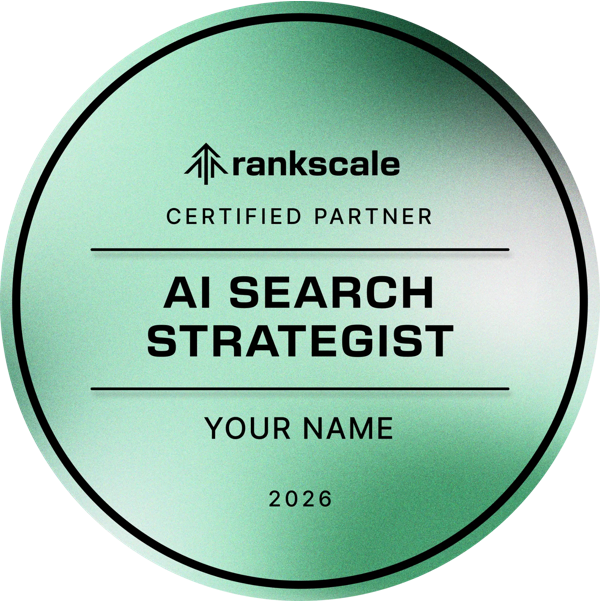
Rankscale AI Certified Partner badge: AI Search Strategist

Certified Partner badge with your name and the year. Complete all six assignments.

For your agency
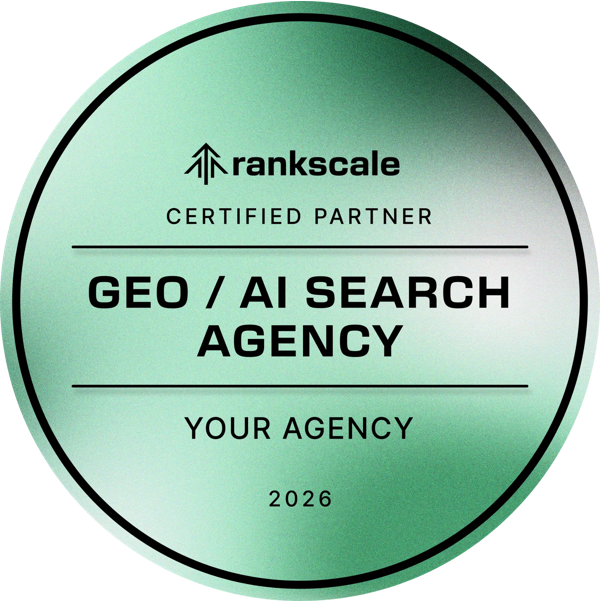
GEO / AI Search Agency badge

Rankscale AI Certified Partner badge: GEO / AI Search Agency

Certified Partner badge with your agency name and the year. Tick "agency badge" in the Module 1 form and hand in all assignments.

  1. 1 Watch the module
  2. 2 Do the assignment in Rankscale AI
  3. 3 Submit the form under the video
  4. 4 Get your badge after Module 7

Watch, do, submit.

Work through all eight modules, complete each hands-on task, and submit your assignment to earn your badge.

Module 1

How AI search works

Learn how ChatGPT, Perplexity, Google AI Overviews, Gemini, Copilot, and Claude decide which brands to mention, cite, and trust.

  • Why AI answers vary run to run, and why you run each prompt 7 to 10 times before trusting a score
  • Mentions vs citations vs sources, and why sentiment decides whether you get recommended
  • Which engines to track, query fan-out, branded vs non-branded visibility
  • How to prove ROI: AI referral traffic, branded search lift, direct traffic lift, self-reported attribution
  • Four ways to be invisible to AI crawlers: firewalls, robots.txt, JavaScript, and not being indexed in Google, Bing, or Brave

Video lesson

Watch on YouTube
Key insights from Module 1

Recap: How AI search engines build their answers, the concepts that matter, and how to make sure AI crawlers can reach your site at all.

  • 11:55: One run is a coin toss. AI answers are probabilistic. Run each prompt 7 to 10 times before you trust a visibility score.
  • 12:18: Four metrics to act on: mention, sentiment, citation, and source. A source is used but not credited, a citation is credited.
  • 13:41: Three layers, three speeds. Training data changes with each new model, user context changes instantly, live web search changes within days. New content can move the web layer fast.
  • 16:07: Sentiment decides whether you get recommended. AI engines act like salespeople: if they only hear bad things, or find nothing, they steer buyers away.
  • 17:02: More content is not the answer. Blasting out AI pages or self-promotional listicles gets penalised, and engines drop the self-ranked brand from the answer.
  • 25:08: Query fan-out: one prompt triggers many hidden sub-searches. You do not need to rank for one query, you need to be findable across the fan-out.
  • 28:26: Split branded from non-branded. Branded visibility should sit above 95%. Non-branded is the real battleground.
  • 29:53: Self-report beats referral tracking. Rankscale AI sees 5x more customers say they found us via AI than AI referrals show.
  • 30:42: Four ways to be invisible: a web application firewall, robots.txt, JavaScript rendering, and not being indexed in Google, Bing, or Brave. Put critical content in the HTML.
  • 36:47: The passage is judged, not the page. A small brand with one well-aimed paragraph can beat a big brand. Backlinks matter far less than SEO intuition says.

Assignment: Crawler access

Create your Rankscale AI account, add your brand, and run a Page Audit V2 on your key pages to check whether AI crawlers can reach your site.

Module 2

Setting up prompts

Build a prompt set that shows exactly where ChatGPT, Google AI Overviews, and Copilot leave your brand out, then find the prompt to fix first.

  • One core prompt expanded into 12 to 48 tagged variations (funnel, scope, branded, persona, geography, language)
  • Where to find real prompts: Prompt Research, Google Search Console, sales calls, review sites
  • Which engines to track by buyer type, and how often
  • The seven AI visibility metrics and their benchmarks

Video lesson

Watch on YouTube
Key insights from Module 2

Recap: How to build a tagged prompt group, pick engines and tracking frequency, and use seven metrics to find the prompt to fix first.

  • 01:22: One core prompt, 12 to 48 variations, built from four variables: branded or not, funnel phase, scope or geography, and persona. Tag every variable so you can filter.
  • 02:08: Keep prompts short. No filler or question words: every extra word adds noise, and engines strip them from their own sub-queries anyway.
  • 04:07: European brands: track English too. AI engines often run their sub-queries in English, which favours brands with English content.
  • 11:37: Where real prompts come from: Prompt Research, a Google Search Console regex filter, sales calls, support tickets, G2, Capterra, Trustpilot, and competitor FAQ pages.
  • 14:53: Engines follow the buyer. Enterprise: Copilot, ChatGPT, AI Overviews, Claude. SMB: ChatGPT, Copilot, AI Overviews. Consumers: ChatGPT and AI Overviews. Add Mistral for France, Claude and Grok for developer tools, Perplexity for marketers.
  • 21:48: Wait for seven runs before you read the data or start fixing.
  • 23:22: Benchmarks: branded visibility above 95% (below 90% is an entity problem), sentiment above 65% means endorsed, below 55% is a warning, average position worse than 7 is a red flag.
  • 26:11: Read the pattern: high mentions with low sources is a content gap, low mentions with high sources is a brand attribution gap, both low is an entity emergency.
  • 32:53: The Citations tab shows why you are invisible. In the Drei example, a competitor YouTube video with only 12k views was what Google AI Overviews cited.

Assignment: Setting up prompts

Build a prompt group of at least 12 tagged prompts in Search Terms and share the link to your Rankscale AI dashboard showing it.

Module 3

Content and grounding pages

Find the content AI engines cite instead of yours, rewrite your pages so they get quoted, and build a grounding page that stops AI getting your brand wrong.

  • Three ways to find content gaps: Citations tab, Sources tab, exporting AI responses
  • The six gaps that stop content getting cited, starting with a 40 to 80 word BLUF
  • Justification attributes from the Sentiment tab, question-format headers
  • Grounding pages: what they are and how to build one

Video lesson

Watch on YouTube
Key insights from Module 3

Recap: How to find the content AI engines cite instead of yours, rewrite pages so they get quoted, and build a grounding page.

  • 01:12: Two principles to judge any tactic: token economics (content that is cheaper to process gets favoured) and game theory (serve the engine's goal of an objective answer, do not try to game it).
  • 03:31: It works: the experiment site howtoaustria.com covers 74% of hundreds of tracked prompts by following these rules.
  • 04:49: Three ways to find gaps: the Citations tab, competitors' top URLs in the Sources tab, and exporting full AI responses into an AI assistant to group what keeps getting cited.
  • 17:00: Six gaps that stop citations: a 40 to 80 word bottom line up front (BLUF), justification attributes, freshness, evidence and data, FAQ, and the answer near the top.
  • 17:56: Freshness and data pay off. Pages updated in the last 30 days earn up to 3x more citations, quantified claims up to 40% more visibility, and most citations come from the first 35% of a page.
  • 20:12: Justification attributes counter market complaints. Aura Frames repeats "no subscription fees" everywhere because that is the category's top complaint.
  • 21:00: Write headers as questions and put a number on every claim.
  • 22:39: AI drafts, people own it: strategy, brand voice, positioning, and E-E-A-T stay human. Remove the tell-tale AI phrasing before you publish.
  • 29:12: Grounding pages are factual, machine-readable pages that remove four risks: hallucinations, entity confusion, non-inclusion, and English retrieval bias.

Assignment: Content and grounding

Submit four things: (1) a content gap summary, (2) a rewritten BLUF dated and grounded with justification attributes, (3) the justification attributes you used, and (4) four question-format headers with a standalone answer paragraph each.

Module 4

SEO and page structure

Make every page easy for AI engines to reach, read, and quote: heading hierarchy, schema, chunks, and consistent entity names.

  • Four ways a page fails the machine: crawl access, semantic structure, schema, chunkability
  • One H1, no skipped heading levels, and the accessibility tree
  • Which schema type for which page, in JSON-LD that mirrors the visible text
  • Running the schema and HTML hierarchy check in Page Audit V2

Video lesson

Watch on YouTube
Key insights from Module 4

Recap: How to make every page easy for AI engines to reach, read, and quote.

  • 00:57: Four ways a page fails the machine: crawl success, semantic structure, schema markup, and chunkability.
  • 02:06: Cheaper to read means more likely cited. Engines follow token economics.
  • 02:34: One H1, never skip a heading level. A broken hierarchy produces broken retrieval chunks. Check it with View Source, not the browser.
  • 03:39: The accessibility tree is the agent's map. Browser agents navigate by real headings, buttons, landmarks, and alt text.
  • 04:18: Declare, do not make engines guess: Article, FAQPage, HowTo, Product or Offer, LocalBusiness, and Organization schema, in JSON-LD that mirrors the visible text.
  • 05:44: One name per entity, everywhere. Aura Frames keeps "Aura Frame" and "Aura app" consistent across 432 pages. Check yours with a site: search.
  • 12:49: Every URL follows one structure: nav around the menu, content in article, one section per topic, dates in a time element.

Assignment: SEO and readability

Run Page Audit V2 on a URL you want to improve and check your HTML hierarchy. Submit whether it passes, a screenshot of the result, and, if it fails, why.

Module 5

PR, citations, and your entity

Find the third-party pages AI engines trust, get your brand onto them, and trace false claims about you back to the site that spreads them.

  • The four PR gaps: entity, third-party citations, sentiment, authority
  • Joining sources of truth: Wikidata, LinkedIn, Crunchbase, Knowledge Panel, your grounding page
  • Finding false information with "why not" prompts and the Sentiment tab
  • Finding the comparison portals, blogs, and directories cited without you, and prioritising them

Video lesson

Watch on YouTube
Key insights from Module 5

Recap: What other sites say about you now shapes whether AI engines recommend you. How to close entity gaps, get onto the pages AI trusts, and correct false claims.

  • 01:37: Four PR gaps: entity, third-party citations, sentiment and reputation, and authority.
  • 03:16: Join the sources of truth: Wikidata, LinkedIn, Facebook, X, Crunchbase, and the Google Knowledge Panel, plus your own grounding page. A grounding page can even outrank the official page on Google.
  • 04:35: Hunt false information on purpose. Track prompts like "why should I not use [brand] as an expat" under one tag, then follow each negative claim in the Sentiment tab to the page behind it and ask the publisher to correct it. Hotel Sacher fixed a false "no pool" claim this way.
  • 08:38: Find the pages to get on: filter the Citations tab without your brand. Every domain cited without you is an outreach target.
  • 10:24: Four places to get cited: partner ecosystems (G2, Salesforce AppExchange), editorial (Forbes, Wikipedia, HARO), community (Reddit, YouTube, TikTok), and niche blogs.
  • 11:44: One identical description on every profile, so engines know what your brand stands for.
  • 12:43: Prioritise by citation share, and by URL over domain. The cited URL is what moves the answer. Backlinks and domain authority matter far less than in classic SEO.

Assignment: PR

Check that you are listed and described consistently across your social profiles and relevant directories. Send the 3 top-cited pages you need to get mentioned on (or ranked higher on), and 3 negative keywords from the Sentiment tab that may need correction at the source.

Module 6

Habits and operating rhythm

AI visibility fades when nobody owns it. Set up five cadences, one owner each, that keep your brand in AI answers.

  • The responsibility brief: brand, baseline date, target, two primary engines, contributors
  • The three priorities in order: improve, create, get listed
  • What ships weekly, biweekly, monthly, every two months, and quarterly, and who owns it

Video lesson

Watch on YouTube
Key insights from Module 6

Recap: How to turn Modules 1 to 5 into an operating rhythm with five cadences and one owner each.

  • 00:00: GEO fails when nobody owns the cadence. Name an owner, set the rhythm, write it down.
  • 01:00: Five cadences: weekly, each contributor ships one named priority. Biweekly, the GEO lead sets the next priorities. Monthly, the ROI readout. Every two months, new sub-queries. Quarterly, a full review.
  • 01:00: One GEO lead, three contributors: SEO and readability, content, and PR and entity. Working solo means wearing all four hats.
  • 05:19: Set up once: reachability, two primary engines, money prompts first, and a seven-day baseline with GA4 and self-attribution wired in before anyone changes a page.
  • 07:19: Three priorities, in order: improve content that already wins, create new winning content, then get onto the third-party pages that matter.
  • 08:20: Never delete a row from the action log, even after a quiet week. It is what justifies the budget later.
  • 11:33: Flag any 10-point drop on a money prompt, and focus on citations that appear across more than one engine.
  • 14:28: Check the WAF monthly. CDN providers sometimes change policies and start blocking AI crawlers.
  • 17:27: Buy placements one quarter at a time, then recheck whether the page is still cited.

No assignment for this module

Use this module to turn your other assignments into a weekly routine.

Module 7

Reporting

Prove what your AI search work is worth: four attribution paths, a report for each audience, and custom dashboards your board will actually read.

  • Four ways to prove value: AI referrals, branded search lift, direct traffic lift, self-reported attribution
  • One report per audience: board or client monthly, marketing lead biweekly, practitioner weekly
  • Building custom dashboards in Rankscale AI and connecting Looker Studio

Video lesson

Watch on YouTube
Key insights from Module 7

Recap: How to prove what AI search work is worth, report it to each audience, and build the dashboards that keep the budget coming.

  • 01:44: Four attribution paths: AI referral clicks, branded search lift, direct traffic lift, and self-reported attribution.
  • 03:17: Ask "how did you hear about us?" Five times as many Rankscale AI customers report finding us via AI as AI referral tracking shows.
  • 04:27: One report per audience: board or client monthly, marketing lead biweekly, practitioner weekly. If everyone gets the same report, you are doing it wrong.
  • 06:38: Four rules for every report: one metric that tells the story, anchored to a competitor or benchmark, the input behind it, and the next action.
  • 08:00: A number needs context. 12% visibility means nothing; 12% against a peer median of 18% is a gap you can close.
  • 09:40: Four dashboards: funnel health, niche dominance, engine gap, and scenario proof on long-tail prompts, where wins come fastest.
  • 17:32: Report the inputs too. Mark actions done in the Recommendations tab so the board sees what moved the number.

Assignment: Reporting

Build one custom dashboard with a non-branded visibility widget per funnel phase (awareness, consideration, transactional) and paste its URL. Add one sentence for your board or client: where you stand, where your main competitor stands, and what budget closes the gap.

Momentum checkpoint

Ready to build your AI search system?

Keep going with your own brand data and close each assignment in Rankscale AI.

Start your free trial

Who this bootcamp is for

In-house marketing and SEO teams who want to own AI visibility
Founders and growth teams who need measurable AI search momentum
Agencies who run AI search visibility work for client brands
Agencies who want to price and sell AI search work

Frequently asked questions

Is it live or recorded?

Recorded. All eight modules are on YouTube and on this page, so you can start any time and go at your own pace.

Is it free?

Yes. The videos, the assignments, and the badge are free.

Do I need a Rankscale AI account?

To do the hands-on parts, yes. A free trial is enough to follow along.

How long does it take?

About four hours of video. Plan extra time for the assignments, which you do on your own brand.

How do I earn the badge?

Complete the assignments in Modules 1, 2, 3, 4, 5, and 7 and submit them through the form. Modules 6 and 8 have no assignment.

Is it for agencies or in-house teams?

Both. Modules 1 to 7 work for any team. Module 8 is for agencies that want to price and sell AI search work.

Do I need SEO experience?

Basic SEO knowledge helps. We explain every AI search concept from the start.

Build your AI search system, one module at a time.

Free. Eight modules. Work on your own brand in Rankscale AI.